Updated May 2026: I’ve refreshed this guide with a clearer CCI formula, better notes on overbought and oversold signals, divergence, settings, and an updated Python walkthrough.
Introduction to CCI
The Commodity Channel Index, usually shortened to CCI, is a momentum oscillator that measures how far price is trading from its recent average.
Despite the name, CCI is not only for commodities and it does not draw a price channel on the chart. Donald Lambert introduced it for cyclical commodity markets, but traders now use it on stocks, futures, forex, indices and other markets where price tends to swing around a moving average.
CCI is centred around zero. Positive readings mean price is above its average. Negative readings mean price is below its average. The further CCI moves away from zero, the more stretched price is relative to its recent average deviation.
That makes CCI useful in two different ways. In a range, high positive readings can warn that price is stretched to the upside, while deep negative readings can warn that price is stretched to the downside. In a strong trend, those same readings can show acceleration rather than immediate reversal risk.
The mistake is to treat +100 as an automatic sell signal and -100 as an automatic buy signal. CCI can stay elevated during a strong uptrend or depressed during a strong downtrend. The useful question is not only where CCI is, but what the price chart is doing while CCI is there.
CCI Indicator at a Glance
Before getting into the formula, it helps to separate what CCI is measuring from how traders often use it.
CCI measures price’s distance from its moving average, adjusted by recent mean deviation.
The zero line marks the point where price is close to its average.
Positive CCI readings mean price is above its average.
Negative CCI readings mean price is below its average.
Readings beyond +100 or -100 are often treated as stronger moves away from the average, but CCI is not bounded. It can move far beyond those levels in a strong trend.
For me, the cleanest way to read CCI is that the indicator shows how stretched price is from its recent average, while the chart decides whether that stretch is trend strength, exhaustion, or just noise.
CCI Formula
The Commodity Channel Index compares the current typical price with its recent average, then scales that distance by the recent mean deviation.
The important detail is the word mean deviation. Standard CCI uses the average absolute distance from the moving average, not standard deviation. That distinction matters when we later code the indicator in Python.
| Symbol | Meaning |
|---|---|
t | current bar |
n | lookback period |
Hₜ | high at the current bar |
Lₜ | low at the current bar |
Cₜ | close at the current bar |
TPₜ | typical price at the current bar |
SMA(TP)ₜ | simple moving average of typical price |
MDₜ | mean deviation of typical price from its average |
CCIₜ | Commodity Channel Index value at the current bar |
1. Calculate typical price
The typical price combines the high, low and close into one price input for the bar.
TP_t = \frac{H_t + L_t + C_t}{3}Typical price equals current high plus current low plus current close, divided by three.
2. Calculate the moving average of typical price
Next, calculate a simple moving average of typical price over the chosen lookback period.
SMA(TP)_t = \frac{TP_t + TP_{t-1} + \cdots + TP_{t-n+1}}{n}The moving average of typical price is the average of the typical prices over the selected lookback period. A 20-period CCI uses the last 20 typical price values.
3. Calculate mean deviation
Mean deviation measures how far the typical prices in the lookback window are from their moving average. Each distance is made positive with an absolute value, then the distances are averaged.
MD_t = \frac{1}{n} \sum_{i=0}^{n-1} \left| TP_{t-i} - SMA(TP)_t \right|Mean deviation equals the average absolute difference between each typical price in the lookback period and the current moving average of typical price.
4. Calculate CCI
CCI_t = \frac{TP_t - SMA(TP)_t}{0.015 \times MD_t}CCI equals current typical price minus the moving average of typical price, divided by 0.015 times the mean deviation.
What the 0.015 constant does
The 0.015 constant is a scaling factor. It helps place many CCI readings inside the familiar +100 to -100 area, but it does not create a hard boundary.
CCI is unbounded. It can move above +100, below -100, and in strong moves it can push well beyond +200 or -200. Those levels are reference zones, not automatic trade instructions.
The formula explains why CCI behaves differently from a simple momentum line. It is not only asking whether price has risen or fallen. It is asking how far the current typical price is from its recent average compared with the normal deviation around that average.
What the Commodity Channel Index Measures
CCI measures price location relative to a recent average.
When CCI is near zero, the typical price is close to its moving average. When CCI is positive, typical price is above that average. When CCI is negative, typical price is below it.
The further CCI moves from zero, the more stretched price is relative to its recent mean deviation. That stretch can mean different things depending on the market.
In a range, a high positive CCI reading may warn that price is stretched to the upside. A deep negative reading may warn that price is stretched to the downside.
In a strong trend, the same readings can mean something else. CCI above +100 can show upside momentum rather than an immediate reversal setup. CCI below -100 can show downside momentum rather than an automatic oversold bounce.
| CCI reading | Common interpretation | Main caution |
|---|---|---|
| Around zero | Price is close to its recent average | Direction may be unclear |
| Above zero | Price is above its recent average | Does not guarantee an uptrend |
| Below zero | Price is below its recent average | Does not guarantee a downtrend |
| Above +100 | Upside strength or overbought stretch | In a trend, this can be continuation |
| Below -100 | Downside strength or oversold stretch | In a trend, this can be continuation |
| Beyond +200 or -200 | Extreme stretch from the average | Extreme does not mean immediate reversal |
This is why CCI is often described as both a momentum indicator and an overbought/oversold indicator. Both descriptions can be true, but not at the same time on every chart.
For trend trading, I would watch whether CCI is breaking above +100 or below -100 and whether price is confirming the move. For mean reversion, I would first want evidence that the market is ranging, otherwise the indicator can stay stretched while price keeps moving.
The useful habit is to read CCI in layers. First, check whether it is above or below zero. Then check whether it is near a reference level such as +100 or -100. Finally, look at the price chart to decide whether that reading looks like strength, exhaustion, or noise.
How to Interpret CCI Signals
CCI signals are easiest to read when you separate range signals from trend signals.
In a range, a move above +100 can warn that price is stretched above its recent average. A move below -100 can warn that price is stretched below its recent average. In that kind of market, traders often watch for failed moves back inside the range as possible mean-reversion signals.
In a trend, the same reading can mean something very different. CCI above +100 can show strong upside momentum. CCI below -100 can show strong downside momentum. Fading those readings too early can mean trading against the move.
| CCI signal | Possible interpretation | Main caution |
|---|---|---|
| CCI crosses above zero | Price is moving above its recent average | Weak crosses can chop around the zero line |
| CCI crosses below zero | Price is moving below its recent average | Not every cross begins a trend |
| CCI rises above +100 | Upside momentum or overbought stretch | In an uptrend, this can be continuation |
| CCI falls below -100 | Downside momentum or oversold stretch | In a downtrend, this can be continuation |
| CCI pushes beyond +200 | Strong upside extension | Extreme does not mean immediate reversal |
| CCI drops below -200 | Strong downside extension | Extreme can become more extreme |
| CCI diverges from price | Momentum may be weakening | Divergence can appear early and persist |
The zero line is useful, but I would not treat every zero-line cross as a trade. In a choppy market, CCI can cross above and below zero repeatedly while price goes nowhere. The cross is more useful when it lines up with price structure, such as a breakout, a failed breakdown, or a pullback that holds.
The +100 and -100 levels are more useful as context zones than as automatic triggers. A move above +100 says price is strong relative to its recent average. A move below -100 says price is weak relative to its recent average. Whether that creates a trade depends on the chart.
For a trend-following trader, a push above +100 may support a bullish setup if price is also breaking resistance or holding above a rising average. For a mean-reversion trader, the better signal may come later, when CCI fails to hold above +100 and price starts to roll back toward its average.
The bearish version works the same way. A fall below -100 may support a short setup in a weak market. In a range, a failed push below -100 can warn that downside pressure is fading.
| Setup type | What the trader looks for | Confirmation to watch |
|---|---|---|
| Bullish trend continuation | CCI pushes above +100 while price holds a higher-low structure | Breakout hold, rising average, strong close |
| Bearish trend continuation | CCI falls below -100 while price holds a lower-high structure | Breakdown hold, weak bounce, strong close lower |
| Bullish mean reversion | CCI drops below -100 or -200, then turns back up | Failed breakdown, support hold, higher low |
| Bearish mean reversion | CCI rises above +100 or +200, then turns back down | Failed breakout, resistance hold, lower high |
| Zero-line confirmation | CCI crosses zero after price structure has already shifted | Avoid isolated crosses in chop |
The safer habit is to treat CCI as a momentum and stretch gauge. It can show that price has moved far from its average, but it cannot decide whether that move is the start of a trend, the end of a trend, or a noisy false break. Price structure has to make that call.
CCI Divergence and Trend Confirmation
Divergence is one of the more useful CCI signals, but it is also one of the easiest to overread.
A bullish CCI divergence happens when price makes a lower low, but CCI makes a higher low. That can suggest downside momentum is weakening.
A bearish CCI divergence happens when price makes a higher high, but CCI makes a lower high. That can suggest upside momentum is weakening.
The key word is suggest. Divergence is a warning sign, not a complete trade. Price can keep trending after divergence appears, especially in strong markets.
| Divergence type | Price action | CCI action | Possible reading | Main caution |
|---|---|---|---|---|
| Bullish divergence | Lower low | Higher low | Downside momentum may be weakening | Price still needs to reclaim structure |
| Bearish divergence | Higher high | Lower high | Upside momentum may be weakening | Trend may continue despite weaker CCI |
| Hidden bullish divergence | Higher low | Lower low | Trend pullback may be holding | Needs an existing uptrend |
| Hidden bearish divergence | Lower high | Higher high | Bear-market rally may be failing | Needs an existing downtrend |
| No divergence | Price and CCI confirm each other | Both move in same direction | Trend pressure may still be intact | Late entries can still be risky |
For a bullish divergence, I would not buy only because CCI made a higher low. I would want to see price stop falling, hold support, break a short-term downtrend line, or reclaim a prior level. Without that, the divergence may only be an early warning.
For a bearish divergence, I would not short only because CCI made a lower high. I would want to see price fail at resistance, lose a higher-low structure, or move back below a key average. Strong trends can produce several bearish divergences before price finally turns.
CCI can also be used for trend confirmation. If price is breaking higher and CCI is also pushing above +100, the indicator is confirming upside momentum. If price is breaking lower and CCI is moving below -100, the indicator is confirming downside momentum.
The cleaner trend-confirmation signals usually happen when price and CCI agree. The more cautious signals happen when price makes a new extreme but CCI does not follow.
| Price and CCI behaviour | Possible interpretation | What I would check next |
|---|---|---|
| Price breaks higher and CCI moves above +100 | Upside momentum confirms the move | Breakout hold, volume, resistance above |
| Price breaks lower and CCI moves below -100 | Downside momentum confirms the move | Breakdown hold, support below, news risk |
| Price makes a new high but CCI does not | Upside momentum may be fading | Failed breakout, lower high, weak close |
| Price makes a new low but CCI does not | Downside momentum may be fading | Failed breakdown, higher low, support hold |
| CCI crosses zero after price has shifted | Momentum is catching up with price | Whether the cross happens in trend or chop |
The practical way to use CCI divergence is to treat it as a reason to pay closer attention. It can warn that a move is losing force, but it should not replace the chart. A divergence becomes more useful when it lines up with support, resistance, a failed break, a change in swing structure, or another clear shift in price behaviour.
CCI Settings and Parameters
The standard CCI setting is often 20 periods. That means the indicator compares the current typical price with the average typical price over the last 20 bars.
The word period simply means the chart bar being used. On a daily chart, 20 periods means 20 trading days. On a five-minute chart, it means 20 five-minute candles.
The lookback period controls how quickly CCI responds. A shorter setting reacts faster, but it also creates more noise. A longer setting reacts more slowly, but it can give a cleaner view of broader price swings.
| CCI setting | Behaviour | Possible use | Main trade-off |
|---|---|---|---|
| Shorter than 20 | Faster and more sensitive | Intraday testing, shorter swings, earlier turns | More whipsaws |
| 20 periods | Common baseline | General chart reading and platform comparison | May lag sharp reversals |
| Longer than 20 | Slower and smoother | Swing trading, broader cycles, fewer signals | Later confirmation |
| Higher reference level | Fewer extreme signals | Filtering for stronger stretches | May miss useful earlier warnings |
| Lower reference level | More frequent signals | Shorter-term mean reversion or alerting | More false signals |
Reference levels are part of the setup too. Many traders watch +100 and -100, but those levels are not hard limits. Some traders also watch +200 and -200 for more extreme stretches.
Changing the reference level changes the signal frequency. A trader reacting to every move above +100 will see far more signals than a trader waiting for +200. That does not make one approach automatically better. It changes the balance between early warning and cleaner confirmation.
The danger is optimising the CCI setting until it fits the last few trades perfectly. A setting that looks excellent on one chart may fail when volatility, trend strength or market rhythm changes.
I would start with a common baseline, such as 20 periods, then test any changes against that baseline. If a shorter setting improves one trade but creates five extra false signals, it may not be an improvement.
| What you see on the chart | Possible issue | What to test |
|---|---|---|
| CCI crosses zero constantly | Setting may be too short or market may be choppy | Longer lookback or stronger price filter |
| CCI rarely reaches +100 or -100 | Setting or market may be too slow for those thresholds | Shorter lookback or lower reference level |
| CCI spends long periods beyond +100 or -100 | Strong trend may be in place | Avoid automatic fade signals |
| Divergence appears too often | Chart may be noisy or timeframe too low | Higher timeframe confirmation |
| Signals arrive late | Setting may be too long | Compare with a shorter baseline |
Settings should match the role CCI plays in the strategy. If CCI is used as a trend-confirmation tool, a slower setting may be acceptable. If it is used for short-term stretch warnings, a faster setting may be worth testing. The setting should be written down and tested, rather than changed for each instrument after the fact just because a different period would have fitted the last few swings better.
Pros and Cons of the CCI Indicator
CCI is useful because it compresses a lot of information into one oscillator. It tells you whether typical price is above or below its recent average, and how stretched that move is relative to recent mean deviation.
That makes it useful for spotting momentum, overextension, divergence and possible trend shifts. The danger is treating those readings as automatic trade signals.
| Strength | Why it helps |
|---|---|
| Shows distance from average | Helps identify when price is stretched from its recent typical-price average |
| Works in both directions | Positive readings show upside stretch; negative readings show downside stretch |
| Useful for momentum confirmation | Moves above +100 or below -100 can support trend-following ideas |
| Useful for mean-reversion warnings | Extreme readings can flag stretched conditions in range-bound markets |
| Can highlight divergence | Price and CCI disagreement can warn that momentum is weakening |
The weaknesses mostly come from using CCI without market context.
CCI is unbounded, so it can keep rising above +100 or falling below -100 during a strong trend. A trader who automatically sells every move above +100 or buys every move below -100 can end up fighting the strongest part of the move.
CCI also depends heavily on settings. A shorter lookback can make the oscillator noisy. A longer lookback can make it slower. The same level can behave differently on a daily stock chart, an intraday futures chart or a quiet currency pair.
| Limitation | What can go wrong |
|---|---|
| Unbounded oscillator | Extreme readings can become more extreme |
| Can stay overbought or oversold | Fading +100 or -100 mechanically can fight strong trends |
| Sensitive to settings | Short periods can create whipsaws; long periods can lag |
| Divergence can appear early | Momentum may weaken long before price reverses |
| No risk level | CCI does not provide a stop-loss, target, or position size |
| Formula errors are common | Using standard deviation instead of mean deviation creates a different calculation |
Used well, CCI can help decide whether price is stretched, whether momentum is confirming a move, or whether momentum is starting to diverge. Used badly, it becomes another oscillator that encourages traders to fade strong trends too early.
Coding the CCI Indicator with Python
Now we can calculate CCI in Python and plot it under a price chart.
The important point is that this version uses mean deviation, not standard deviation. That keeps the Python calculation aligned with the formula above.
The example below downloads price data, calculates a 20-period CCI, then plots price, volume and CCI in separate panels.
Step 1: Install the Python libraries
python -m pip install pandas yfinance numpy matplotlib mplfinanceIf your Windows setup uses the py launcher, this version may work better:
py -m pip install pandas yfinance numpy matplotlib mplfinancePandas handles the data table, yfinance downloads the price data, NumPy helps with the CCI calculation, matplotlib builds the chart, and mplfinance provides the candlestick plotting function.
Step 2: Create the file and import the libraries
Save a new file as cci_indicator.py, then paste the following imports at the top.
import numpy as np
import pandas as pd
import yfinance as yf
import matplotlib.pyplot as plt
from mplfinance.original_flavor import candlestick_ohlcStep 3: Add the chart settings
ticker = "6B=F"
start_date = "2025-05-10"
end_date = "2026-05-10"

cci_period = 20This example uses British Pound Sterling vs USD futures and a 20-period CCI. The same script can be reused with another ticker or date range by changing these settings.
Step 4: Download the price data
data = yf.download(
    ticker,
    start=start_date,
    end=end_date,
    auto_adjust=True,
    progress=False,
    multi_level_index=False
)

if isinstance(data.columns, pd.MultiIndex):
    data.columns = data.columns.get_level_values(0)

data.index = pd.DatetimeIndex(data.index)
data = data.dropna(subset=["Open", "High", "Low", "Close", "Volume"])

if data.empty:
raise ValueError("No price data downloaded. Check the ticker and date range.")The auto_adjust=True setting means the OHLC data is adjusted for splits and dividends. The MultiIndex fallback is included because yfinance can return multi-level columns depending on version and settings.
Step 5: Define the CCI calculation
def calculate_cci(price_data, period=20):
    df = price_data.copy()

    typical_price = (df["High"] + df["Low"] + df["Close"]) / 3

    tp_sma = typical_price.rolling(window=period).mean()

    mean_deviation = typical_price.rolling(window=period).apply(
        lambda values: np.mean(np.abs(values - values.mean())),
        raw=True
    )

    df["CCI"] = (typical_price - tp_sma) / (0.015 * mean_deviation)

return dfThe mean_deviation line is the key part. It calculates the average absolute distance between typical price and its moving average over the lookback window. This is not the same as standard deviation.
Step 6: Add the CCI column
data = calculate_cci(data, cci_period)

plot_data = data.dropna(subset=["CCI"]).copy()

if plot_data.empty:
raise ValueError("Not enough valid data to calculate CCI.")The first rows are removed because CCI needs enough bars to calculate the moving average and mean deviation.
Step 7: Prepare the chart data
plot_data["Bar"] = np.arange(len(plot_data))

ohlc = plot_data[["Bar", "Open", "High", "Low", "Close"]].values

volume_colors = np.where(
    plot_data["Close"] >= plot_data["Open"],
    "green",
    "red"
)This prepares the candlestick and volume data for the chart.
Step 8: Create the price, volume and CCI panels
fig, (ax_price, ax_volume, ax_cci) = plt.subplots(
    3,
    1,
    figsize=(12, 7),
    sharex=True,
    gridspec_kw={
        "height_ratios": [4, 1, 1.4],
        "hspace": 0.0
    }
)

fig.suptitle(
    f"{ticker} with {cci_period}-Period Commodity Channel Index",
    fontsize=12,
    fontweight="bold"
)

candlestick_ohlc(
    ax_price,
    ohlc,
    width=0.6,
    colorup="green",
    colordown="red",
    alpha=0.85
)

ax_price.set_ylabel("Price")
ax_price.grid(True, alpha=0.25)

ax_volume.bar(
    plot_data["Bar"],
    plot_data["Volume"],
    color=volume_colors,
    width=0.6,
    alpha=0.55
)

ax_volume.set_ylabel("Volume")
ax_volume.grid(True, alpha=0.25)

ax_cci.plot(
    plot_data["Bar"],
    plot_data["CCI"],
    label="CCI",
    color="blue",
    linewidth=1.2
)

# CCI reference lines
ax_cci.axhline(0, color="black", linestyle="--", linewidth=1.0, alpha=0.9)
ax_cci.axhline(100, color="gray", linestyle="--", linewidth=1.0, alpha=0.9)
ax_cci.axhline(-100, color="gray", linestyle="--", linewidth=1.0, alpha=0.9)
ax_cci.axhline(200, color="red", linestyle="--", linewidth=1.1, alpha=0.9)
ax_cci.axhline(-200, color="green", linestyle="--", linewidth=1.1, alpha=0.9)

# Right-side labels for the reference lines
ax_cci.text(
    1.002, 200, "+200",
    transform=ax_cci.get_yaxis_transform(),
    va="center",
    fontsize=8,
    color="red"
)

ax_cci.text(
    1.002, 100, "+100",
    transform=ax_cci.get_yaxis_transform(),
    va="center",
    fontsize=8,
    color="gray"
)

ax_cci.text(
    1.002, 0, "0",
    transform=ax_cci.get_yaxis_transform(),
    va="center",
    fontsize=8,
    color="black"
)

ax_cci.text(
    1.002, -100, "-100",
    transform=ax_cci.get_yaxis_transform(),
    va="center",
    fontsize=8,
    color="gray"
)

ax_cci.text(
    1.002, -200, "-200",
    transform=ax_cci.get_yaxis_transform(),
    va="center",
    fontsize=8,
    color="green"
)

ax_cci.set_ylabel("CCI")
ax_cci.legend(loc="upper left", fontsize=8)
ax_cci.grid(True, alpha=0.25)The CCI panel includes the zero line, the common +100 and -100 reference levels, and the more extreme +200 and -200 levels. The chart keeps the legend simple by only listing the CCI line, while the horizontal levels are labelled directly on the right.
Step 9: Add date labels, save and show the chart
tick_count = 9
tick_positions = np.linspace(0, len(plot_data) - 1, tick_count, dtype=int)
tick_labels = plot_data.index[tick_positions].strftime("%Y-%m-%d")

ax_cci.set_xticks(tick_positions)
ax_cci.set_xticklabels(tick_labels, rotation=45, ha="right")

plt.setp(ax_price.get_xticklabels(), visible=False)
plt.setp(ax_volume.get_xticklabels(), visible=False)

fig.subplots_adjust(
    top=0.90,
    bottom=0.16,
    left=0.08,
    right=0.94,
    hspace=0.0
)

output_file = "cci_python_chart.png"
fig.savefig(output_file, dpi=150, bbox_inches="tight")

print(f"Saved chart as {output_file}")

plt.show()The script saves the chart as cci_python_chart.png and opens the chart window.
You should get a three-panel chart with price, volume and CCI. The CCI panel shows when typical price is stretched above or below its recent average, using +100 and -100 as reference zones.
It hopefully looks like mine shown below:
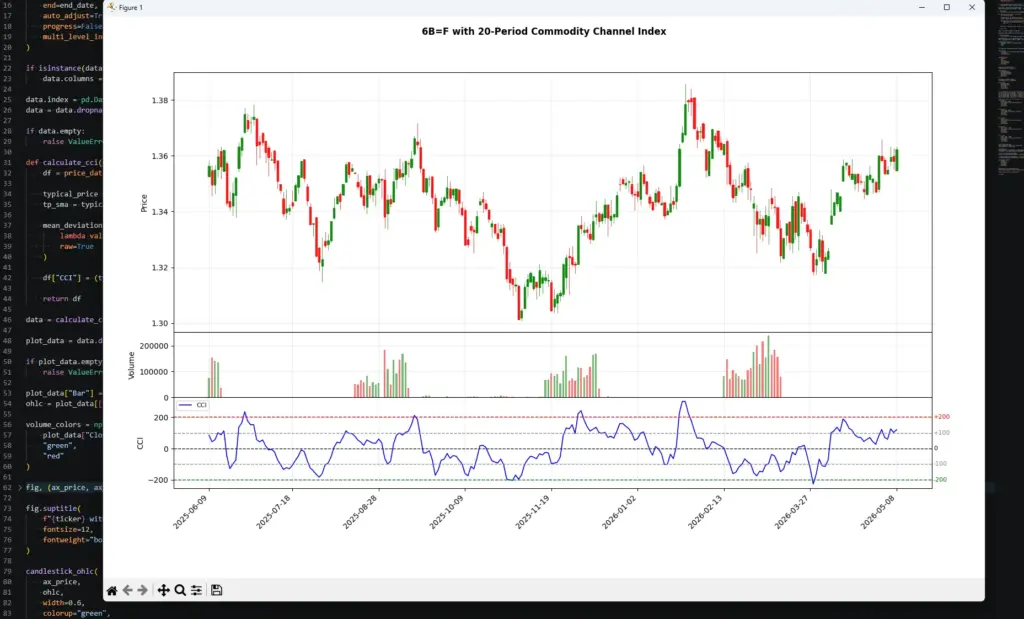
The chart shows CCI doing two different jobs. In the mid-November to early-February recovery, CCI pushes above +100 several times while price is moving higher, so those readings look more like momentum confirmation than automatic overbought sell signals. The sharp dip below -200 around late March is different: price had already weakened and CCI showed an extreme downside stretch, but the useful clue came when price stopped making much downside progress and then began recovering.
By the right side of the chart, CCI is back above zero and holding positive while price has recovered from the March low. That supports the idea that upside momentum has improved, but it still does not create a trade on its own. The price chart still needs to confirm whether the move is breaking into a new trend, stalling near resistance, or simply bouncing inside a broader range.
How to Use CCI for Day Trading
Day trading with CCI needs more caution than using it on a daily chart. Intraday price action is noisy, and CCI can move from overbought to oversold quickly when the market is choppy.
I would not use CCI as a standalone intraday entry signal. It is better used as a momentum and stretch filter.
If CCI is crossing above and below zero repeatedly, the market may not have a clean direction. If CCI pushes above +100 while price is breaking higher, the reading may support upside momentum. If CCI drops below -100 while price is breaking lower, it may support downside momentum.
The mistake is fading every extreme. A move above +100 is not automatically a short. A move below -100 is not automatically a long. On a strong intraday trend day, those readings can show continuation rather than reversal.
| Day-trading situation | What CCI can help show | What still needs checking |
|---|---|---|
| CCI keeps crossing zero | Momentum is unclear | Whether price is simply chopping |
| CCI moves above +100 | Upside momentum or upside stretch | Breakout quality, resistance, entry location |
| CCI moves below -100 | Downside momentum or downside stretch | Breakdown quality, support, entry location |
| CCI reaches +200 or -200 | Extreme stretch from average | Whether price is rejecting or continuing |
| CCI diverges from price | Momentum may be weakening | Price structure confirmation |
For day trading, I would make the process specific.
First, decide whether the session has enough liquidity and movement to trade. A quiet session can make CCI signals look more meaningful than they are.
Second, watch what happens after CCI reaches a reference level. A quick push above +100 and back below it is different from a move that holds above +100 while price keeps breaking higher.
Third, check whether the trade can be managed cleanly. CCI does not provide a stop-loss, target, or position size. A signal is not useful if the trade has poor risk-reward.
Scheduled fundamental news matters as well. Central-bank decisions, inflation data, jobs reports, earnings and major headlines can change the character of the market quickly. CCI reacts to price after the move has already started. It does not know why the move is happening.
| Mistake | Better habit |
|---|---|
| Buying every move below -100 | Check whether the market is trending lower first |
| Selling every move above +100 | Check whether the market is trending higher first |
| Taking every zero-line cross | Avoid isolated crosses in chop |
| Ignoring divergence until price confirms | Treat divergence as a warning, not a trade |
| Changing settings until the last few trades look good | Test settings against a consistent baseline |
Used this way, CCI can help a day trader decide whether momentum is strengthening, fading, or stretched. It should not replace the price chart. The better use is to combine CCI with levels, candles, trend structure, liquidity and known event risk.
CCI vs Other Indicators
CCI is best compared with other indicators by asking what job each one does.
CCI measures how far typical price has moved from its recent average, scaled by mean deviation. That makes it useful for momentum, stretch, divergence and trend-confirmation work.
Other indicators answer different questions. RSI focuses on momentum and stretched conditions. MACD focuses on moving-average momentum. Bollinger Bands frame price with volatility bands. ATR measures range. Parabolic SAR gives trend-following stop-and-reversal points.
| Indicator | Main job | How it differs from CCI | Useful pairing idea |
|---|---|---|---|
| RSI | Measures momentum and overbought or oversold conditions | RSI is bounded; CCI is unbounded | RSI can show stretched momentum while CCI confirms price extension from average |
| MACD | Tracks moving-average momentum | MACD is built from moving averages; CCI is based on typical price deviation | MACD can help with trend direction while CCI shows stretch and momentum |
| Stochastic Oscillator | Shows where price sits within a recent high-low range | Stochastic is range-position based; CCI is deviation-from-average based | Useful for comparing range position with price stretch |
| Bollinger Bands | Show volatility-adjusted bands around price | Bollinger Bands are plotted on price; CCI is an oscillator below price | Bands can show volatility context while CCI shows momentum stretch |
| ATR | Measures average range and volatility | ATR has no direction; CCI has positive and negative readings | ATR can help with stop distance while CCI helps with signal context |
| Parabolic SAR | Gives trend-following stop-and-reversal points | SAR is price-based; CCI is oscillator-based | SAR can help manage a trend after CCI supports momentum |
| Moving averages | Smooth price direction | Moving averages show trend baseline; CCI shows distance from that baseline | A moving average can define trend direction while CCI shows extension |
I would not add indicators just to make the chart look more complete. The better question is always what problem the extra indicator solves.
If CCI is being used for momentum confirmation, a moving average or MACD can help define trend direction. If CCI is being used for mean reversion, Bollinger Bands or support and resistance may help judge whether price is stretched in a broader context. If CCI is being used for entries, ATR can help keep stop placement realistic.
Parabolic SAR can pair with CCI, but I would treat it as one option rather than the obvious companion. CCI may show that momentum is improving, while Parabolic SAR can help trail or frame a trend-following trade. The risk is that both can still whipsaw when the market is messy.
The cleaner approach is to give each tool a job. CCI should not be asked to define trend, entry, exit, stop placement and position size by itself.
Frequently Asked Questions about the CCI Indicator
Q: What is the CCI indicator?
The Commodity Channel Index, or CCI, is a momentum oscillator that measures how far typical price is from its recent average, scaled by mean deviation.
Q: What does CCI measure?
CCI measures price stretch from a recent average. Positive readings mean typical price is above its average. Negative readings mean typical price is below its average.
Q: How is CCI calculated?
CCI is calculated by subtracting the moving average of typical price from the current typical price, then dividing that result by 0.015 times the mean deviation.
Q: What is typical price in the CCI formula?
Typical price is the average of the high, low and close for the current bar.
Q: What is a common CCI setting?
A common CCI setting is 20 periods. Shorter settings react faster but create more noise. Longer settings are smoother but can react late.
Q: What does CCI above +100 mean?
CCI above +100 means price is stretched above its recent average. In a range, that can warn of overextension. In an uptrend, it may confirm upside momentum.
Q: What does CCI below -100 mean?
CCI below -100 means price is stretched below its recent average. In a range, that can warn of downside overextension. In a downtrend, it may confirm selling pressure.
Q: Is CCI a buy and sell signal?
Not by itself. CCI can support a bullish or bearish view, but the trade still needs price structure, risk control and market context.
Q: What is CCI divergence?
CCI divergence happens when price makes a new high or low but CCI fails to confirm it. That can warn that momentum is weakening, but divergence is a warning sign rather than a complete trade setup.
Q: Is CCI better than RSI?
CCI and RSI answer related but different questions. RSI is bounded and focuses on momentum and stretched conditions. CCI is unbounded and measures distance from a typical-price average.
Final Thoughts
CCI is useful because it gives a quick reading of how stretched price is from its recent average.
That makes it helpful for spotting momentum, possible exhaustion, divergence and trend confirmation. The same feature also creates the main trap. A high CCI reading does not automatically mean sell, and a low CCI reading does not automatically mean buy.
In a range, +100 and -100 can help identify stretched areas. In a trend, those same levels can show momentum rather than reversal. That is why the price chart has to come first.
I would treat CCI as a context tool. It can show when price is moving strongly away from its average, when momentum is fading, or when a move is becoming extreme. The trade still needs structure, a defined risk point, and awareness of what is happening outside the indicator panel.
Further Reading
Related AlphaSquawk guides:
RSI, for another oscillator used to judge momentum and stretched conditions.
MACD, for moving-average momentum and crossover signals.
Stochastic Oscillator, for comparing price against its recent high-low range.
Bollinger Bands, for volatility bands around price.
Average True Range, for volatility and stop-distance context.
Parabolic SAR, for a trend-following stop-and-reversal tool.
Moving Averages, for the trend baseline behind many momentum and oscillator systems.
Books and references:
- Commodity Channel Index: Tool for Trading Cyclic Trends, Donald R. Lambert, Commodities Magazine, 1980.
- Technical Analysis of the Financial Markets, John J. Murphy.
- Park, Cheol-Ho and Irwin, Scott, The Profitability of Technical Analysis: A Review (October 2004). AgMAS Project Research Report No. 2004-04, Available at SSRN: https://ssrn.com/abstract=603481 or http://dx.doi.org/10.2139/ssrn.603481 – This paper reviews a large number of studies on the profitability of technical analysis. We review this paper in this article.