Updated May 2026: This futures trading journal guide has been refreshed with practical trade examples, a clearer journal template, rollover checks, economic release notes and a process-vs-outcome review framework.

Key Takeaways
- A futures trading journal should record the reason for the trade, not just entry, exit and profit or loss.
- The main purpose of a journal is to separate process from outcome: a losing trade can be good, and a winning trade can still be bad.
- Futures traders should record contract month, rollover status, scheduled economic releases, market condition, order flow, position size and maximum risk.
- Manual journaling can create more accountability than automated reports, while digital journals are useful for statistics and performance analysis.
- The best reviews look for repeated behaviour: overtrading, moving stops, trading the wrong contract month, losing around news, or performing badly at certain times of day.
- A journal only works if it changes behaviour. The goal is not to create a perfect record; it is to remove repeated mistakes.
Introduction
A futures trading journal is a valuable tool that can help traders improve their decision-making, risk management, and overall performance in the market and ultimately their profitability. By systematically recording and analyzing their trades, traders can gain valuable insights into their trading habits, identify patterns, and make informed adjustments to their strategies.
In this article, we will discuss the benefits of maintaining a futures trading journal, how to structure your own in a notebook, and some of the available digital offerings out there that can help streamline the process. We will also reference research-backed evidence supporting the use of trading journals so you don’t have to just take our word for it.
From my own personal experience that began on a professional trading floor in London over twenty years ago and training traders on many others since, the accountability a journal demands is key in helping traders succeed. It makes you ‘own up’ as to why you entered a trade, or justify why you failed to exit it at the right time. The level of discipline and analysis it enforces is often brushed aside by more casual traders to their detriment.
There is a lot to be said for writing journal entries manually rather than glancing at an automatically generated digital report, as it is human nature not to want to dwell on an often painful review process after things go wrong and with automated reports you can tick it off as being logged, without much due care and attention. By manually keeping a journal you will find it actually shortens your learning curve and path to profitability by exposing you to the best lessons to be learnt for future performance improvement.
Remember, the money lost on a losing trade is the price of the lesson to be learned, so get the most out that lesson seeing as you already paid for it up front.
Why a Futures Trading Journal Matters
A futures trading journal is not just a record of entry price, exit price and profit or loss. If that is all you record, you are only keeping an account statement with extra handwriting.
A useful journal explains the decision.
Why did you enter? What was the setup? What was the risk? What did the order book look like? Was volume moving into a new contract month? Was a major economic release due? Did you follow the plan, or did you improvise once money was on the line?
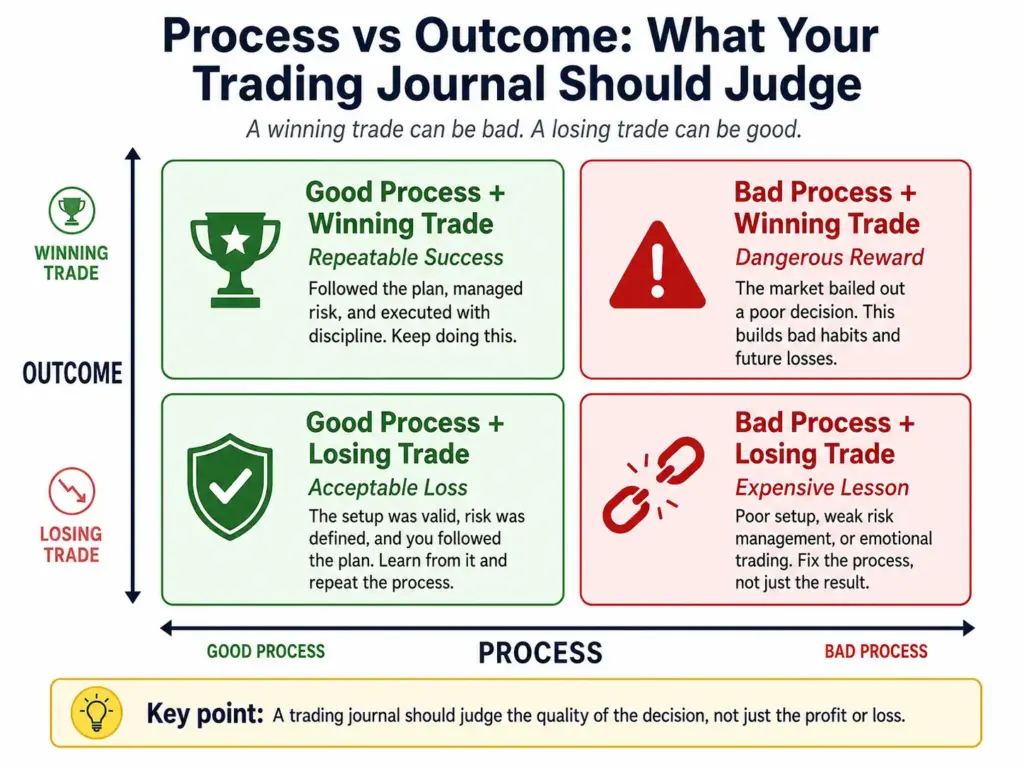
That distinction matters because two trades can have the same financial result but completely different lessons. A losing trade can be a good trade if it followed a tested plan and respected risk. A winning trade can be a bad trade if it came from chasing, over-sizing or refusing to take a stop.
The purpose of the journal is to separate process from outcome.
Futures Trading Journal Template
A futures trading journal should be practical enough that you actually use it. The aim is not to create a beautiful record after the event. The aim is to capture the information that will help you trade better next time.
A simple template should include three layers: market context, trade execution and post-trade review.
Before the trade
- Date and session
- Contract traded, including expiry month
- Front month / active contract checked?
- Market condition: trending, balanced, volatile, thin, news-driven
- Key scheduled events: CPI, NFP, central bank decision, inventory data, auction, OPEC, earnings
- Trade idea and direction
- Entry level, stop level and target or exit logic
- Position size
- Maximum risk in money and ticks
- Three reasons for the trade
- One reason not to take the trade
During the trade
- Actual entry and exit
- Time in trade
- Slippage and fill quality
- Did the DOM / order flow confirm the idea?
- Did the market behave as expected?
- Did you move the stop?
- Did you add, reduce, hesitate or panic?
- Did you break any rule?
After the trade
- Profit or loss
- Was the plan followed?
- Was the trade valid?
- Was the result mostly skill, luck, bad timing or poor discipline?
- What would you repeat?
- What would you avoid?
- Emotional state before, during and after the trade
- Screenshot or chart note
- One-sentence lesson
The examples below are simplified, but they show the main point: the journal is not there to praise winners and punish losers. It is there to judge the quality of the decision.
A good trade can lose money. A bad trade can make money. The journal should help you tell the difference.
Futures Trading Journal Examples
Example 1: A Good Trade That Followed the Plan
Market: Bund futures
Contract: Active front month, checked after rollover
Session: European morning
Setup: Price opened inside yesterday’s range, tested the prior value area high, then held above it with improving bid depth
Trade idea: Long continuation if buyers defended the breakout level
Entry: Bought 1 lot at 132.18
Stop: 132.11, below the failed-breakout area
Target: 132.34, near the next resistance level
Risk: 7 ticks / €70 per contract
Result: Sold at 132.32 for +14 ticks / €140 before costs
Journal review: This was a good trade because the plan was defined before entry. I waited for price to retest the breakout area rather than buying the first spike. The stop was placed where the trade idea would be wrong, not where the loss would feel comfortable. I did not move the stop or add emotionally.
Lesson: Repeat this setup when the market breaks from balance, retests, and order flow confirms buyers are still present.
Example 2: A Losing Trade That Still Deserved to Be Taken
Market: E-mini S&P 500 futures
Contract: Active front month
Session: US cash open
Setup: Market opened above the prior day’s high after stronger overnight trade
Trade idea: Buy the first pullback if the prior high acted as support
Entry: Bought 1 contract at 5312.25
Stop: 5307.25
Target: 5322.25
Risk: 5 points
Result: Stopped at 5307.25
Journal review: This was a losing trade, but not a bad trade. The setup was clear, the contract month was correct, the risk was defined, and the stop was not moved. The failure came because buyers did not defend the prior high after the cash open.
Lesson: The setup is still valid, but I should record whether this performs better after the first 15 minutes of cash trading rather than immediately at the open.
Example 3: A Winning Trade That Was Actually Bad
Market: Crude oil futures
Session: Around weekly inventory data
Setup: None. I entered because price was moving quickly after the release
Entry: Bought after a fast spike
Stop: No clear stop at entry
Target: None
Result: Scratched out for a small profit
Journal review: This trade made money, but it was a bad trade. I reacted to movement rather than waiting for a setup. I did not know the risk before entering, and I had no clear exit plan. The positive result makes the trade more dangerous because it rewards bad behaviour.
Lesson: Do not count this as a successful trade. Mark it as a discipline error. No trades immediately after inventory data unless the plan was written before the release.
Example 4: A Rollover / Wrong Contract Month Mistake
Market: German Bund futures
Date: Rollover week
Mistake: Continued watching and trading the old contract after most volume had moved into the new front month
Result: Poor fills, thinner depth, misleading order-flow read
Journal review: The trade idea was not the main problem. The problem was that I was watching the wrong contract. The old month had technically not expired, but liquidity had already shifted. The DOM was thinner, the spread was less reliable, and the price action was no longer the best representation of the active market.
Lesson: During rollover week, check volume and depth before trading. Roll charts, ladders and DOM when the market moves, not when the expiry calendar finally forces the issue.
Example 5: Trading Too Close to an Economic Release
Market: 10-year Treasury futures
Scheduled event: US CPI
Setup: Short-term technical breakdown before the release
Mistake: Entered five minutes before CPI without a release plan
Result: Slippage through stop after data hit
Journal review: The technical setup looked clean, but the timing was poor. The upcoming CPI release meant the chart pattern had less value. The trade was exposed to event risk, spread widening and a fast repricing.
Lesson: Before every trade, check the calendar. No new short-term trades inside the final 10 minutes before major scheduled data unless the trade is specifically designed for the event.
How to Review Your Futures Trading Journal
Recording trades is only half the job. The improvement comes from review.
Daily review:
At the end of each session, mark each trade as one of three types:
- A-trade: followed the plan and matched your best setup
- B-trade: acceptable but imperfect
- C-trade: emotional, impulsive, oversized or outside the plan
Weekly review:
At the end of the week, look for patterns:
- Which market made or lost the most money?
- Which time of day performed best?
- Did most losses come from valid setups or discipline errors?
- Did you trade worse after a losing trade?
- Did you lose money around news releases?
- Did you trade the correct contract month during rollover?
- Were your best trades planned before entry or chased after movement?
Monthly review:
At the end of the month, update your trading plan. Remove one repeated bad habit. Keep one repeated good behaviour. Do not try to fix everything at once.
Red Flags Your Journal Should Expose
A good trading journal should make uncomfortable patterns obvious.
Common red flags include:
- most losses happen after the first losing trade of the day;
- winners are cut quickly, but losers are allowed to run;
- trades taken near major data releases perform badly;
- one market consistently damages the account;
- performance drops during rollover week;
- position size increases after losses;
- stops are moved only when the trade is losing;
- most profitable trades come from one setup, but most trades are not that setup.
The point is not to punish yourself. The point is to stop pretending the same mistakes are random.
The Benefits of Keeping a Futures Trading Journal
Improved Decision-Making and Pattern Recognition
Keeping any type of trading journal can often seem like a chore, yet it enables traders to analyze their past decisions, identify recurring patterns, and learn from their successes and failures. By consistently recording and reviewing their trades, traders can develop a deeper understanding of their trading behavior and uncover potential areas for improvement while keeping trades controlled and disciplined. This self-analysis can lead to more informed decision-making and ultimately enhance performance. Even if you are running an automated strategy understanding why trades were entered and exited, or what interfered with your coded logic to arrive at an unintended outcome will only help you improve your code and system.
For example, look at your journal for repeating patterns to see:
- The amount of time you hold onto poor trades for.
- If you have three strong reasons to enter the trade, and if they are validated afterwards.
- Whether you are averaging into losing trades.
- If there is a particular market in which you keep dropping money.
- Are you over-trading on losing days?
- If there is a time of day that never seems to benefit you when day trading.
- What common patterns emerge for your good, profitable trades?
- Whether you are losing money around contract roll-over (expiry).
- Whether you are getting caught by economic figures being released you were not aware of, or headlines you or your system are slow to react to.
Enhanced Risk Management
A well-maintained trading journal can help traders refine their risk management strategies. By tracking the outcomes of different risk management techniques, traders can identify which approaches work best for their individual trading style and make necessary adjustments. This isn’t just about where to place stops, it incorporates managing your own ego and avoiding periods that are likely to lose you money. Over time a journal can be invaluable to look back on, for example what was said at the prior ECB or OPEC conference and how did your market react.
As General Norman Schwarzkopf said, ‘Shined shoes saves lives‘ and by taking the same disciplined approach as a trader, by logging your trades and observations, it will feed into your trading when markets are volatile and erratic, while others are losing their heads – journal entries save money.
Structuring Your Futures Trading Journal in a Notebook
The template above explains what to record. The notebook structure is about making those notes easy to complete, easy to review, and difficult to ignore.
A good notebook journal should have a repeatable layout. If every trading day is written in a different format, it becomes much harder to spot patterns. The goal is to build a structure you can use quickly during a live session and still understand months later.
Use a consistent page layout
One simple approach is to split each trading day into four parts:
- Pre-market notes: overnight news, foreign market reactions, key levels, economic releases, central bank speakers, inventory data, auctions or company earnings likely to affect the market.
- Trade log: each trade’s contract, direction, entry, exit, size, stop, target, result and reason for entry.
- Market behaviour: whether the session was trending, balanced, volatile, thin, news-driven, or affected by rollover, expiry or contract-month changes.
- End-of-day review: what you did well, what you did badly, what you should repeat, and what must be avoided next session.
The point is not to write a novel. The point is to make the right information visible. A few clear notes written every day are more useful than a perfect journal that you abandon after a week.
Keep your most important pages at the front
Use the first few pages of the notebook for information you need to see repeatedly:
- your core trading rules;
- your maximum daily loss;
- your maximum position size;
- your main setups;
- your “do not trade” conditions;
- markets or times of day that usually damage your account;
- rollover checks for the contracts you trade;
- major economic releases you must check before trading.
This turns the journal into something more useful than a diary. It becomes a pre-trade guardrail.
Make futures-specific checks obvious
A futures journal should include details that a generic trading journal may miss. Contract month, rollover status, tick value, margin, liquidity, session type and scheduled data releases all matter.
For example, if you are trading during rollover week, write down whether the active volume and DOM depth have moved to the next contract. If your performance drops every rollover, that is not random noise. Your journal should make that obvious.
The same applies to scheduled events. If you keep losing money around CPI, Non-Farm Payrolls, crude oil inventories, central bank decisions, auctions or OPEC meetings, your journal should expose the pattern clearly enough that you can change your rules.
Review the notebook like a trader, not a historian
The review process should be active. Do not simply reread old pages. Look for behaviour you can change.
At the end of each week, mark repeated issues. Did you overtrade after the first loss? Did you move stops? Did you trade too close to data? Did one market keep damaging the account? Did you ignore your best setup and chase weaker trades?
At the end of each month, choose one behaviour to remove and one behaviour to repeat. Trying to fix everything at once usually leads to fixing nothing. The journal becomes powerful when it forces small, repeated improvements.
Digital Trading Journal Offerings
Advantages of Digital Trading Journals
Digital trading journals offer several advantages over traditional notebook journals, including:
- Enhanced data analysis capabilities
- Automatic trade importing and synchronization
- Customizable templates and report generation
- Access to online resources and community support
The disadvantage is that they can be too hands-off, making them less useful for holding yourself accountable for each trade.
Popular Digital Trading Journal Platforms
Some popular digital trading journal platforms include:
- Edgewonk
- Tradervue
- TradingDiary Pro
- TradeBench
- Trademetria
Consider trying out different platforms and choosing the one that best fits your needs, preferences and price point.
A digital journal is useful for statistics. A handwritten or manually written journal is useful for accountability.
The best approach may be to use both. Let software calculate win rate, average winner, average loser, time-of-day performance and market-by-market results. Then use a notebook or written review to explain the decisions behind the numbers.
The software can tell you that you lose money trading the first 10 minutes after the US open. The written journal can tell you why.
Conclusion
A futures trading journal is not just an admin task. Used properly, it becomes a feedback system for your trading. It shows which setups are worth repeating, which behaviours are damaging the account, and which market conditions you should avoid.
The most useful journal records more than entry, exit and profit or loss. It captures the contract month, market context, scheduled events, risk, emotional state, execution quality and the lesson from the trade. That is what separates a learning tool from a basic trade log.
Digital journals are useful for statistics, but manual notes create accountability. The best approach may be to combine both: use software for performance numbers, and use written review to understand the decisions behind those numbers. The goal is not to keep a perfect journal forever. The goal is to stop repeating expensive mistakes.
Further reading on trading psychology, discipline and journaling:
Steenbarger, B. N. (2002). The Psychology of Trading: Tools and Techniques for Minding the Markets. John Wiley & Sons.
Elder, A. (2014). The New Trading for a Living: Psychology, Discipline, Trading Tools and Systems, Risk Control, Trade Management John Wiley & Sons.