In the typically staid pension fund industry, few strategies attract as much attention—or generate as much anxiety—as Liability Driven Investment (LDI). This week, pension scheme managers are once again reporting margin calls on their LDI pension positions. You may recall a similar scenario back in 2022, when then-Prime Minister Liz Truss’ “mini-budget” caused UK government bond (gilt) yields to spike, forcing pension funds to scramble for cash and revealing the leverage hidden in many LDI strategies.
In this article, we take a trader-focused look at how LDI works, why it came under stress after Liz Truss’ mini-budget in 2022, and why fresh pressures from the current Chancellor’s 2024 budget—featuring higher taxes and spending cuts—are contributing to renewed margin calls in January 2025. We’ll also discuss what it all means for the broader economy and for the general public, plus offer some pointers on how the pension risk management landscape might evolve this time around.
What Is LDI?
Liability Driven Investment (LDI) is essentially a large-scale hedge designed to protect pension funds from swings in interest rates and inflation. Think of it as an insurance policy that pays off if yields move in an unfavourable direction. The concept is fairly straightforward:
- Identify Liabilities: Pension trustee responsibilities include meeting long-term payout promises to retirees.
- Match or Hedge These Liabilities: Funds use a blend of government bonds (gilts) and derivatives to offset potential interest rate risks.
From a trader’s perspective, it’s similar to constructing an options or futures strategy around an existing portfolio. The goal is to lock in known outcomes (meeting pension payouts) by hedging against unknowns (interest rate spikes or dips).
In practice, LDI investment strategies often involve leverage—borrowing to amplify the hedge without tying up too much capital in low-yield gilts. This is akin to a prop trader using margin on an options spread: it works smoothly as long as volatility stays within expected bounds, generating stable returns. However, if the underlying moves sharply against you, a margin call is triggered. For pension funds, that “margin call” moment arrived dramatically in 2022 and is happening again this past week.
A Brief History of LDI: Early Successes and the Road to Overleverage
Liability Driven Investment began to gain traction in the early 2000s as a method for pension scheme governance to better match assets to long-term liabilities. Initially, it appeared to be the perfect remedy for underfunded pension schemes:
- Reduced Volatility: Pension schemes that adopted LDI saw more stable funding ratios, as hedging strategies helped smooth out the impact of fluctuating bond yields.
- Lower Deficits: Between 2010 and 2015, many UK defined benefit pension funds reported significantly narrowed funding gaps—some even halved their deficits through LDI pension strategies.
- Growing Market Adoption: By 2020, the total notional value of LDI hedges in the UK had surpassed £1 trillion, reflecting widespread industry confidence in LDI portfolio management.
How Overleverage Crept In
Success, however, introduced new vulnerabilities. As more pension funds allocated larger chunks of their portfolios to LDI solutions, they did so on a leveraged basis—hedging liabilities without tying up excessive capital in gilts. This allowed them to invest in higher-yield assets elsewhere, boosting returns in calm markets but introducing major risks when markets turned volatile:
- Collateral Calls: Leveraged derivatives meant unexpected surges in yields triggered margin calls, forcing pension trustees to find cash quickly.
- Concentration Risk: Many pension schemes employed similar strategies from a small pool of providers, creating systemic vulnerabilities if the market shifted too fast.
- Underestimation of Volatility: UK gilts were historically viewed as stable. That perception changed dramatically in 2022.
Why the Industry Was Caught Off Guard
- Complacency in a Low-Rate Environment: Years of low interest rates lulled many into believing large moves were unlikely.
- Regulatory Comfort: Regulators generally encouraged LDI strategy pension funds because it aligned with matching liabilities and assets, meaning the embedded leverage went relatively unchecked.
- Market-Wide Adoption: A sudden, sharp yield spike prompted a domino effect of margin calls and forced selling across the industry.
While LDI pension strategies did help bolster funding levels for many UK pension funds, the 2022 meltdown demonstrated just how perilous overconfidence can be when bond markets move unexpectedly.
Recap of the 2022 Mini-Budget Meltdown
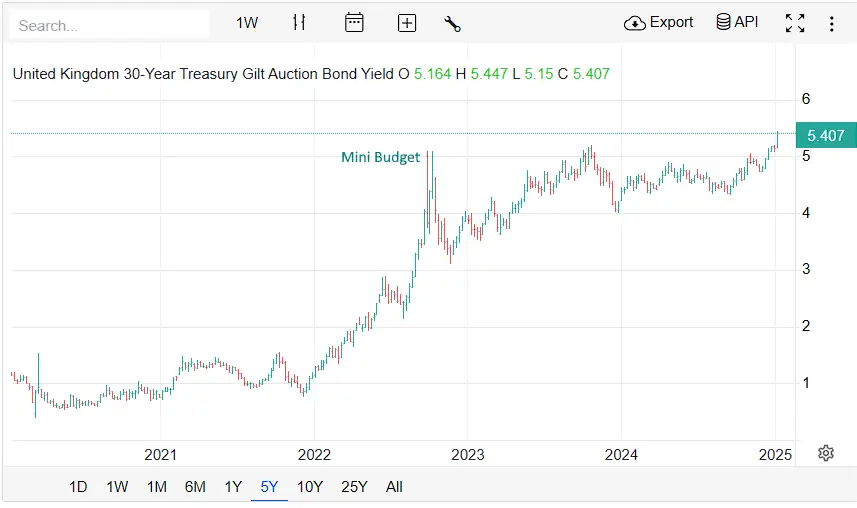
When Liz Truss rolled out her “mini-budget” in late 2022—promising tax cuts with no clear plan to offset the revenue loss—bond markets were spooked. Yields on 30-year UK gilts skyrocketed at a record pace, sending LDI collateral demands through the roof. The consequences were swift and severe:
- Yields Soared: UK gilts saw one of their biggest weekly spikes in decades.
- Margin Calls Flooded In: Overleveraged pension funds were forced to sell assets rapidly to meet these collateral requirements.
- Bank of England Intervention: The BoE stepped in with emergency actions to stabilize markets.
The episode revealed that even a so-called safe approach to pension scheme governance could transform into a high-risk bet if bond yields moved too far, too fast.
Fast-Forward to 2025: Another Big Test
Recently, yields on 30-year gilts reached new multi-decade highs—according to some measures, a 26-year peak—driven by persistent inflationary fears and mounting concerns over the UK’s economic trajectory. For the first time since 2022, pension funds are facing large collateral calls on LDI positions. The silver lining is that many pension trustees appear better prepared:
- Reduced Leverage: Post-2022, regulators and consultants urged schemes to cut back on leverage, minimizing the risk of forced asset sales.
- Greater Liquidity Buffers: Funds have bolstered liquidity cushions to handle collateral calls without having to dump assets at bargain prices.
- Stricter Regulatory Oversight: Both The Pensions Regulator and the Bank of England have tightened their scrutiny, encouraging more robust pension risk management.
Though some pension schemes are still scrambling to post additional collateral, market participants say the process is smoother this time around. The question remains: Will that calm hold if yields spike even further?
The Chancellor’s 2024 Budget: Taxes, Spending Cuts, and Market Ripples
Last year’s 2024 budget introduced sweeping tax hikes and harsh spending cuts, aimed at shrinking the UK’s deficit. Although these measures were largely expected, they nonetheless place downward pressure on growth. From a trading standpoint:
- Bond Market Implications: Higher taxes plus reduced spending could lead to economic stagnation (or stagflation if inflation stays sticky), which may keep yields elevated or climbing.
- Equity Market Impact: Companies reliant on consumer spending could face revenue declines, potentially affecting pension portfolio allocations.
- Currency Fluctuations: The British pound has been volatile. After peaking around 1.34 to the dollar in September 2024, it has since declined, hitting new lows of around 1.22 last week.
This climate adds yet another layer of uncertainty for LDI pension strategy, even though many funds are (theoretically) in a more resilient position than in 2022.
Why Should the General Public Care?
It’s easy to dismiss LDI as arcane financial engineering. However, the ramifications for ordinary citizens can be substantial:
- Pension Security: If pension funds can’t meet collateral calls, future payouts may be jeopardized.
- Economic Ripple Effects: Forced selling to cover margin calls can push asset prices lower, affecting broader stock and bond markets.
- Potential Government Intervention: If instability intensifies, the Bank of England might step in again, influencing interest rates and ultimately household borrowing costs (e.g., mortgages).
When LDI pension strategies fail, the risk can extend to taxpayers through potential bailouts, making this an issue that everyone has a stake in.
Are They Better Prepared This Time?
The consensus among pension advisors and asset managers is that lessons from 2022 have been learned:
- Strengthened Collateral Buffers: Pension funds are holding more readily accessible cash or liquid assets.
- Improved Monitoring: Many now employ real-time or frequent stress testing to anticipate margin requirements.
- Enhanced Risk Management: Tighter rules around how much leverage can be used in LDI portfolio management.
Still, no risk framework is fool proof. If yields surge again or if conditions worsen faster than expected—especially under the weight of the 2024 budget’s austerity measures—another crisis could loom.
LDI 2.0: A Resurgence with Reduced Leverage
While the 2022 mini-budget crisis revealed the vulnerabilities of Liability Driven Investment (LDI), it didn’t eliminate the strategy’s popularity. By late 2024, it was clear that LDI was making a comeback—albeit in a more cautious form. Several developments underscore this resurgence:
- Popularity Remains High
- Four key providers—Legal & General, Insight Investment, Schroders, and Columbia Threadneedle—confirmed that pension funds have continued or even increased their use of LDI tools.
- LGIM noted that hedging ratios among its defined benefit pension clients now stand at around 86-87% of their liabilities, up from around 80% just two years prior.
- Leverage Levels Are Down
- According to data from The Pensions Regulator last October, the total value of leveraged LDI positions now sits nearer £600-700 billion, roughly half the level of late 2021.
- Higher interest rates have boosted pension funds’ overall funding positions, allowing them to reduce leverage.
- Bigger Liquidity Buffers
- Post-crisis, schemes are required to set aside more liquid collateral—such as corporate bonds that can be quickly converted to cash—to meet potential margin calls.
- Pooled LDI funds now often hold enough collateral to withstand yield moves of up to 3 percentage points, whereas before 2022 many were braced for only around 1.5-2 points.
- Regulatory Pressure and Preparedness
- Regulators continue to emphasize robust risk management and encourage funds to maintain more accessible collateral.
- While pension schemes are better funded than they have been in years, market experts admit that the new LDI architecture, dubbed “LDI 2.0,” remains largely untested in extreme conditions.
Names Facing Margin Calls This Week
According to a Reuters report by Carolyn Cohn and Iain Withers (January 10, 2025)1, the recent gilt selloff has spurred fresh margin calls for some UK pension funds using LDI strategy pension funds.
- XPS and Gallagher confirm some funds were instructed to post more collateral, yet describe the process as orderly compared to 2022.
- BlackRock, a major LDI provider, also noted that schemes are better prepared this time around, though it remains “vital” to keep monitoring collateral levels closely.
- Other key LDI providers like Legal & General, Insight Investment, and Schroders report that despite the market stress, the system is functioning more smoothly than during the 2022 crisis.
- BT pension fund manager Brightwell similarly says pension funds are “well prepared,” managing volatility effectively.
Yields on the 30-year UK government bond soared to a 26-year high, prompting concerns reminiscent of the 2022 mini-budget meltdown. While the margin calls are significant, industry insiders believe the overall pension scheme governance framework is sturdier now, reducing the likelihood of a dramatic chain reaction.
Final Thoughts
For traders eyeing these developments, the takeaway is clear: LDI investment strategies remain under the microscope, particularly in a climate of stubborn inflation, uncertain economic growth, and a newly austere fiscal policy. Pension trustee responsibilities have expanded to include more rigorous pension risk management practices and pension scheme governance to ensure that leverage and liquidity are carefully balanced.
Yet despite improvements, the fundamental challenges persist: high leverage, volatile yields, and policy surprises can still catch the market off guard. As we watch January 2025 unfold, the question isn’t whether LDI strategies can work—most agree they can—but whether the pension funds utilizing them have truly internalised the lessons of 2022 and built resilient enough structures to weather the next storm.
- “UK gilt selloff triggers pension cash calls in first big test since 2022 crisis,”
by Carolyn Cohn and Iain Withers, Reuters, January 10, 2025, 9:56 PM GMT+4 ↩︎