
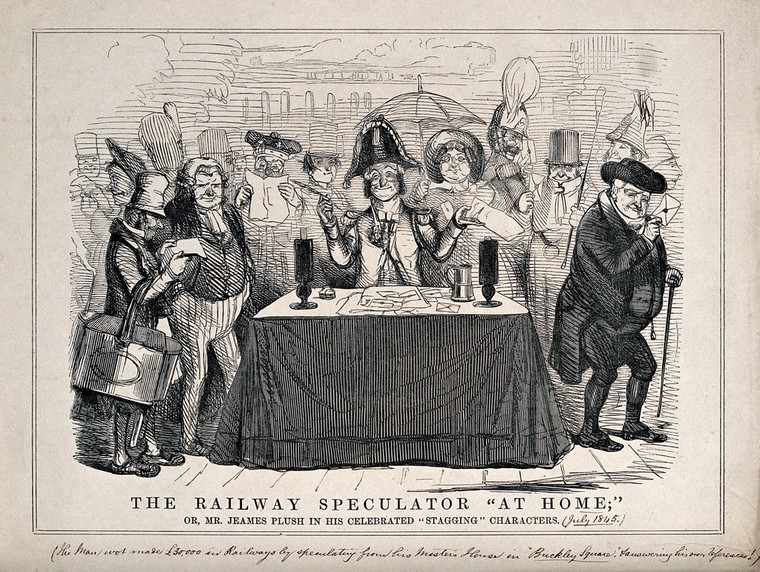
In 1827, a Yorkshire draper named George Hudson inherited a small fortune. Within twenty years he was one of the most powerful men in Britain, with railways stretching across the country, grand houses, political influence and even a private railway station. A few years later he was fleeing creditors. The trains, meanwhile, kept running.
There is a reason to revisit Hudson now. America is spending extraordinary sums on artificial intelligence, from model development to data centres and electricity supply. China and other competitors are making capable AI available at ever lower prices, while the cost of financing the build-out is rising. The history of Britain’s Railway Mania raises an awkward question: what if the people funding the next great infrastructure revolution are not the people who make the money from it?
How a York draper became the Railway King
Hudson was born in 1800, the son of a farmer near the city of York. Orphaned young, he was apprenticed to a draper, married his employer’s daughter and became a partner in the business. He was already prosperous when a great-uncle died in 1827 and left him an inheritance estimated at roughly £30,000, equivalent to around £3 million (~$4m) in today’s money. That gave him the freedom to think rather bigger than the next shipment of cloth. [1]
York wanted better connections to the industrial towns around it. Hudson began backing railway schemes, learned the business by travelling with surveyors, and developed a talent for joining short local lines into something more useful. He became chairman of the York and North Midland Railway, worked alongside the celebrated engineer George Stephenson and helped assemble routes reaching towards Newcastle. By 1844 he controlled more than 1,000 miles of railway. He was also Lord Mayor of York and soon an MP (member of parliament). [1][2]
It is easy to see why people believed in him. A journey that once meant slow roads and awkward transfers could suddenly be made by rail. Towns wanted stations, merchants wanted faster deliveries, shareholders wanted a piece of the growth. Hudson understood the value of a connected network long before most of the country had one.
His success brought an irony worthy of today’s technology sector. In 1845 he opposed a proposed direct London–York railway because the shorter route threatened traffic on lines he already controlled. The great champion of a disruptive technology had become an incumbent defending his market. [1]
The dividend that was really your own money
Railways were expensive to build, and companies found ingenious ways to attract investors. Many issued partly paid shares. Someone subscribing to a £100 share might initially put down £10, with the company entitled to demand the remaining money in instalments as construction progressed. A rising share price made the arrangement attractive. A falling price did not cancel the obligation to keep paying. [3]
Then came the promises of income. Some of Hudson’s companies paid dividends that their railway operations had not earned. Investigations subsequently found that money raised from shareholders to finance the business had been used to fund distributions presented as profits. [2]
Suppose investors contribute £100 to build a line. If the company earns £8 after expenses and distributes £5, that is an ordinary dividend paid from earnings. If it earns nothing and hands investors £5 from the original £100, it has simply returned some of the money intended for construction. Calling that payment a dividend makes the venture look more successful than the trains have actually made it.
Hudson’s reputation and generous payouts helped support confidence while his companies expanded. When the accounts were examined, the picture was much less flattering. At the Eastern Counties Railway alone, a historical review records about £200,000 in dividends paid from investors’ capital. His dealings also included manipulation of accounts and transactions that benefited him personally. He was forced out of his railway chairmanships in 1849. [2]
One of the people caught in the wreckage was Charlotte Brontë. In a September 1849 letter, she described her York and North Midland shares, originally issued at £50, having once reached £120 before falling to £20. The line had previously paid a 10% dividend. Readers who have watched a fashionable growth stock collapse after years of reassuring results may recognise the experience. [4]
The shares crashed. The railway network kept growing.
The wider mania had already turned before Hudson’s disgrace. Railway shares peaked in August 1845. That November, The Times calculated that financing all the proposed projects would require an astonishing £590 million, more than Britain’s annual economic output at the time. It was a measure of commitments being contemplated, not money already spent. [5]
Projects could not simply be switched off when enthusiasm cooled. Parliament had authorised lines, contractors had been engaged and shareholders faced further calls for cash. Then the economy turned against them. Poor harvests and expensive food imports drained gold reserves; the Bank of England tightened credit; and the wider Commercial Crisis of 1847 made money much harder to obtain. Railway speculation had started weakening in 1845, but the credit squeeze arrived while much of the construction bill was still outstanding. [6]
By April 1850, one historical index of railway shares had fallen roughly 64% from its 1845 peak. Yet the railway network had grown from about 2,240 miles in 1844 to 6,621 in 1850. The lines were real, the journeys were useful, and many of the shareholders were considerably poorer. [7]
That gap between the success of the infrastructure and the returns to its financiers is the heart of the AI comparison. It becomes more uncomfortable when money itself gets expensive.
The cost of money has entered the AI story
The giant US technology companies have a distinct advantage over Hudson’s speculative railway promoters: Microsoft, Alphabet, Amazon and others possess established businesses capable of producing substantial cash. But the wider AI expansion also involves heavily financed data centres, specialist operators and huge commitments to equipment whose earning power will be tested over years.
In October 2026, Reuters cited Morgan Stanley’s estimate that AI infrastructure may require $1.5 trillion of external financing by 2028. Just as that financing is needed, the war involving Iran has helped push up energy prices and inflation expectations. On 8 October, the UK’s 10-year gilt yield reached 5.527%, its highest since 2007. Higher government yields can lift the returns lenders demand elsewhere, while electricity costs directly affect the economics of running large computing facilities. [8][9]
There is an echo of 1847 here, although today’s sovereign-bond sell-off is not itself a banking crisis. A project expected to earn its returns far into the future becomes less attractive when debt costs more to service. We explored the route from war and oil prices to yields, credit and valuations in our guide to bond markets and why war moves everything. It is now a very practical question for the AI build-out.
The IMF added a timely warning on 13 October: in one downside scenario, a steep fall in AI investment and asset prices could reduce global GDP by 1.1% by 2028. That is a scenario, rather than a forecast, but it illustrates how much of the wider economy has become linked to the spending cycle. [10]
What happens when everyone can build a better train?
Hudson’s other difficulty was competition. New lines could take passengers from established routes, undermining projections made when a company appeared to control the obvious way between two cities. In AI the contest is moving even faster, because a competitor does not always need to spend the same amount of money to provide a similar service.
Stanford’s 2026 AI Index finds that the measured performance gap between leading US and Chinese models has effectively closed on important benchmarks. China has done far more than reproduce Western work. Its researchers are producing capable models of their own, frequently distributing the weights so that other developers can adapt or deploy them. [11]
Hugging Face examined 178 Chinese model releases larger than 20 billion parameters in the first seven months of 2026. Among them, 59% used Apache 2.0 licences and 22% used MIT licences, both relatively permissive. Some of the very largest newer models have begun imposing extra conditions, and open-weight does not necessarily mean that training data and the entire development process are open. Even with those qualifications, the direction is striking. [12]
Think about the pharmaceutical industry. Developing a new medicine can be ruinously expensive, but patents and regulatory exclusivity offer a period during which the developer can try to recover that investment before generic competition arrives. AI developers have patents, trade secrets and other protections, yet they generally cannot stop independent rivals from developing competing models based on publicly known methods. A discovery made at immense expense in one laboratory can inform cheaper approaches elsewhere.
The economics are already moving. Stanford measured a more than 280-fold fall between November 2022 and October 2024 in the price of obtaining roughly GPT-3.5-level performance on a particular benchmark. Frontier training remains expensive; the point is that yesterday’s impressive capability can become tomorrow’s commodity. As smaller models improve and personal computers gain memory and processing power, more tasks can be handled locally, without a continuing fee to a distant model provider. [13]
The danger for investors is easy to understand. A company can spend billions creating the most powerful model available, only to find that customers can soon obtain 90% of what they need elsewhere for a fraction of the price. Whether that happens across most valuable uses is still an open question. It is a poor foundation, however, for assuming that today’s premium pricing will last indefinitely.
Who gets the tracks after the financiers have gone?
The physical legacy may prove more durable. Data-centre buildings, grid connections, fibre networks, cooling equipment and backup systems have an obvious resemblance to railway tracks, bridges and stations. The AI chips inside them are closer to rolling stock, though their economic life can be considerably shorter than that of a locomotive. Their resale value and competitive usefulness can fall rapidly as newer hardware and more efficient software arrive.
Useful capacity could therefore survive an expensive mistake. A future operator might buy an overbuilt facility cheaply and run profitable services on it, much as later railway operators benefited from infrastructure whose first shareholders had suffered. It will depend on the site: a building with poor power access or obsolete cooling is not automatically a bargain. Still, society can end up with very valuable assets even where the original financing went badly wrong.
Governments have a habit of developing an interest in privately financed infrastructure once it becomes sufficiently important. Britain’s Railway Regulation Act of 1844 reserved conditional powers to purchase certain new railways after 21 years or regulate fares when profits reached a specified threshold. Prussia went considerably further, eventually turning its nationalised railway network into a substantial source of Treasury revenue. [14][15]
Washington is now exploring its own variations on the theme. Having taken a stake in Intel in 2025, the Trump administration began discussing government ownership of AI companies themselves. By June 2026, officials were considering whether such holdings should benefit individual Americans through Trump Accounts or flow into a sovereign wealth fund. Then came an intriguing development: reports in July suggested that OpenAI had itself proposed giving the US government a 5% equity stake, with other AI developers potentially following suit. The proposal remained preliminary, but the historical parallel is hard to miss. Investors finance a technological revolution, governments recognise its strategic importance, and suddenly there is a discussion about who deserves a share of the proceeds. [17][18]
There are good reasons the AI story might end more happily for its backers. Cheaper intelligence may lead to vastly more usage, so revenue grows even while the price of each task falls. Distribution, proprietary data, reliability, chips and enterprise integration can create durable advantages. And the largest technology groups are far better placed to absorb setbacks than most Victorian railway companies were.
Those are arguments for examining cash flow rather than counting model launches. How full are the new data centres? How much of their demand comes from genuinely paying end users? What must be spent to replace ageing accelerators? And after financing costs, how much profit remains? The answers will matter more than whether AI continues to amaze us.
Hudson died in 1871. His coffin was carried back to York by train, an apt final journey for a man who had helped give Britain a railway network and lost control of his fortune along the way. [16]
A century and a half later, investors may once again finance an extraordinary public benefit at a price they cannot recover. We may all enjoy the journey, even if the original shareholders wish they had bought their tickets differently.
There is one final difference worth remembering. The trains didn’t think for themselves.
Sources and references
- York Civic Trust, “George Hudson (1800–1871)” — biography and the estimated value of his inheritance
- Arnold and McCartney, “Managerial Failure in Early Victorian Britain,” Business History (2022)
- Campbell, “Deriving the Railway Mania,” Financial History Review (2013)
- Charlotte Brontë’s letter of 27 September 1849, reproduced in the Yorkshire Almanac
- Atta-Darkua, Bruner and Miller, “Causes and Dynamics of Equity Market Run-ups and Bubbles,” Journal of Applied Corporate Finance (2025)
- Bank of England, “The Bank of England and Central Bank Credit Rationing during the Crisis of 1847” (2019)
- Campbell and Turner, “The Railway Mania: Not So Great Expectations?”, CEPR (2009); and Arnold and McCartney (2022)
- Reuters, “Morning Bid: Feeding the AI Beast” (9 October 2026)
- Reuters, “UK 10-year Borrowing Costs Rise to 19-year High after Oil Prices Jump” (8 October 2026)
- Reuters, “IMF Flags Risks to Global Economy from AI Market Correction, War and Debt” (13 October 2026)
- Stanford HAI, AI Index Report 2026
- Hugging Face, “State of Open Models: Summer 2026 Observations”
- Stanford HAI, AI Index Report 2025: Research and Development
- Railway Regulation Act 1844, sections 1–2
- Fremdling, “Freight Rates and State Budget: the Role of the National Prussian Railways 1880–1913”; Intel’s 2025 federal equity agreement; and Intel announcement (22 August 2025)
- Science Museum Group, “George Hudson” — final years and burial
- Semafor (17 June 2026), “Trump Advisers Weigh Structure of AI Stakes” — discussions of Trump Accounts and a sovereign wealth fund.
- Reuters (2 July 2026), “OpenAI Proposes Handing Trump Administration a 5% Stake, FT Reports” — preliminary government equity proposal.




Leave a Reply